

Providers
Learn how to connect and manage a Provider account.
Payment Providers overview
This section describes the Payment Provider side of the process. You can learn how to add Payment Providers' accounts and enable them to be used further in a payment lifecycle. The section serves as a centralised point and tends to simplify the connection flow, allowing you to manage multiple Providers and Payment methods via a single interface.
What is a Payment Provider?
A Payment Service Provider (PSP) is a third-party company that enables Merchants to accept various types of payments. PSPs are mediators between Customers and Merchants. They cooperate with Acquiring banks and Card networks to allow Merchants to receive payments. Also, the PSPs have to follow PCI DSS Compliance to ensure data protection and the highest security standards.
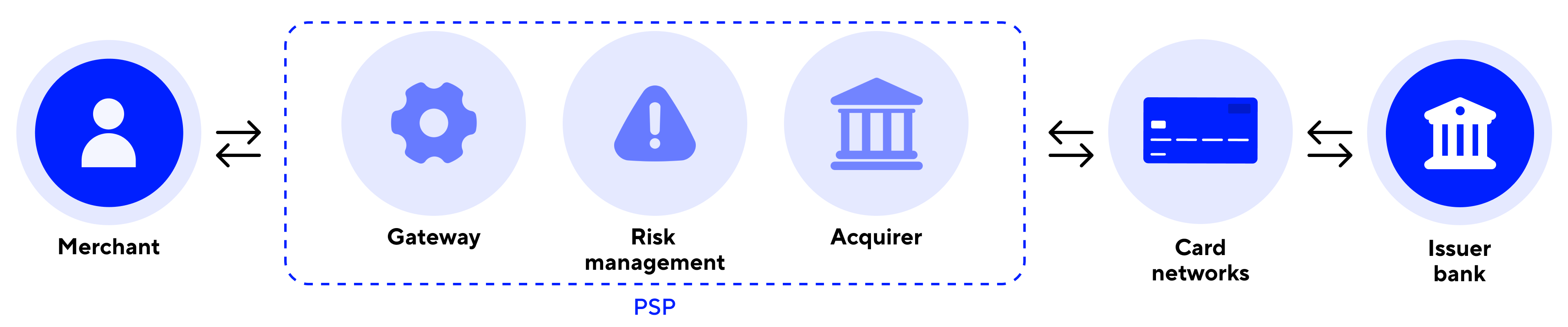
Catalogue of multiple Providers
The possibility of adding multiple Providers ensures an efficient transaction process. Thus, we can single out some more advantages while dealing with various Providers:
- The foundation for constant business scalability and growth.
- The increased conversion rates.
- The decreased dependency on one Provider which leads to a smooth and ongoing process.
- Adding new Payment methods that expand flexibility.
- High diversification of possible risks.
IP whitelist for Providers
To ensure stable Provider connectivity and uninterrupted processing, it is highly recommended to add IP addresses to your Provider whitelist before starting the integration process.
Configuring IP whitelisting in advance helps prevent connection issues and significantly speeds up development, testing, and the activation of all available MIDs.
Production Environment
Add the following IP addresses for the PROD environment:
- 35.159.183.92
- 35.156.183.175
- 3.69.202.238
Development Environment
Add the following IP addresses for the DEV environment:
- 3.65.208.231
- 3.73.206.208
Updated 12 days ago